

Feeling overwhelmed by daily pressures? You are not alone. Stress is a common part of modern life, but it doesn't have to control you. Finding effective tools for stress relief is essential for protecting your mental health. This guide explores various mindfulness practices that can help you calm your mind, manage difficult emotions, and find a greater sense of peace. Whether you're considering your first therapy session or simply looking for self-help strategies, these techniques can make a real difference. If you are thinking about seeking professional help, it’s helpful to know that counselling in Houston typically costs between $100 and $200 per session, depending on the therapist’s experience and specialization.
Stress is more than just a feeling of being busy or worried; it’s your body's natural stress response to a perceived threat. While this response is helpful in short bursts, long-term exposure can lead to serious health problems and affect your overall well-being.
Understanding how stress impacts you is the first step toward managing it. Left unchecked, it can contribute to mental health conditions like anxiety and depression. Techniques like cognitive behavioral therapy often address these patterns, and mindfulness, when used in counseling, helps you observe your stress response without judgment, giving you power over it.
The causes of stress are everywhere in our everyday life. What one person finds stressful, another might not, but some triggers are nearly universal. Chronic stress often stems from ongoing situations rather than single events. People often discuss these issues in counseling to find coping strategies.
Common topics include work pressure, financial worries, relationship difficulties, or major life changes. These persistent stressors can lead to significant mental health issues if not addressed. Some of the most frequent causes of stress include:
Your personal and family history can also play a role in how you experience and cope with stress. Understanding your unique triggers is a crucial step in learning how to manage them effectively and prevent them from overwhelming you.
Your body’s response to stress is both physical and emotional. You might notice distinct physical sensations when you're under pressure, which is your body’s way of signaling that something is wrong. Recognizing these signs is key to protecting your physical health.
During your first counseling session in Houston, a therapist may ask about these symptoms to understand your situation. Common physical manifestations of stress include:
Emotionally, stress can make emotion regulation feel impossible, leading to irritability, anxiety, or a persistent low mood. These are common mental health issues that people bring to therapy. Your first session is a safe space to discuss these feelings without judgment and begin creating a plan to address them.
So, how can you start to manage this stress? This is where mindfulness comes in. A consistent mindfulness practice helps you anchor yourself in the present moment, rather than worrying about the future or dwelling on the past. This shift in focus has a powerful, positive effect on your mental health.
In counseling sessions, mindfulness helps you become an observer of your thoughts and feelings without getting carried away by them. This detachment allows you to respond to stressors more calmly and intentionally. A therapist might guide you through simple exercises to help you build this skill. The benefits include:
By learning to stay in the present, you can interrupt the cycle of stress and find more peace in your daily life. It’s a skill that empowers you to take control of your well-being, both inside and outside of therapy.
A mindfulness practice is not just one single activity; it’s a collection of techniques designed to train your attention and awareness. These practices can have a significant positive effect on your mental health by teaching you to engage with the world more intentionally.
In counseling sessions, mindfulness helps by creating a space between a trigger and your reaction, allowing for more thoughtful responses. By incorporating these simple exercises into your life, you can actively reduce stress and improve your overall well-being. Let's look at what mindfulness is and how you can get started.
Mindfulness is the basic human ability to be fully present, aware of where we are and what we’re doing, and not overly reactive or overwhelmed by what’s going on around us. It involves paying attention to the present moment on purpose and without judgment. This practice is a core component of many forms of mindfulness meditation.
How does it work to improve mental health? By focusing on your breath, thoughts, and bodily sensations, you train your brain to step back from negative thought patterns. This process aids in emotion regulation, as you learn to acknowledge feelings like anxiety or anger without letting them take over.
In a counseling session, a therapist might use mindfulness to help you identify and manage difficult emotions as they arise. This practice gives you the tools to calm your nervous system and approach challenges with greater clarity, fostering mental resilience and peace.
The positive effect of mindfulness extends to both your mental and physical health. By regularly practicing, you can fundamentally change your relationship with stress and improve your overall quality of life. Building trust in your ability to handle challenges is a key outcome.
In a therapeutic context, mindfulness provides a foundation for deeper work. It helps calm the body's stress response, making it easier to engage in therapy and process difficult experiences. The benefits you can expect include:
Ultimately, mindfulness is a powerful tool for self-care. It helps you connect with yourself in a compassionate way, which is essential for both mental and physical wellness. A therapist can guide you, but the practice itself empowers you to take an active role in your healing journey.
You don’t need to set aside hours each day to benefit from a mindfulness practice. The key is to weave small, mindful moments into your existing daily routines. This approach makes the practice sustainable and helps prevent stress-related health problems over the long term.
Start by choosing simple activities you already do and decide to perform them mindfully. You can go at your own pace, adding more as you get comfortable. Some easy ways to start include:
In counseling, a therapist might help you identify opportunities in your day to practice mindfulness. By integrating these small habits, you strengthen your mental health and build a foundation of calm that supports you through life's challenges.
One of the simplest yet most powerful tools for stress relief is mindful breathing. When you feel overwhelmed or experience anxiety, your breath often becomes shallow and rapid. Intentionally slowing it down can send a signal to your brain to calm down.
Many counseling services in Houston for managing stress incorporate mindful breathing as a foundational skill. It's a technique you can use anywhere, at any time, to regulate your mental health. Let’s explore a few easy exercises you can try right now.
Deep breathing is a fundamental practice for managing anxiety and calming your stress response. This technique involves taking slow, deep breaths that engage your diaphragm, which helps activate the body's relaxation response and improve your mental health.
When you feel stressed, take a moment to notice the physical sensations in your body. Then, find a comfortable position and try this simple exercise:
In counseling, a therapist might teach you this technique to help you ground yourself during moments of high stress. By focusing on the physical act of breathing, you can shift your attention away from anxious thoughts and restore a sense of calm.
For immediate relaxation, box breathing is an incredibly effective technique. It helps regulate your automatic stress response by creating a simple, predictable rhythm for your breath. This practice brings you into the present moment and has a powerful positive effect on your nervous system.
The technique is easy to remember because it follows a "box" pattern with four equal sides. Here’s how you do it:
In therapy, box breathing is often taught as a practical tool for managing panic or high-stress situations. By giving your mind a simple task to focus on, you can interrupt spiraling thoughts and guide your body back to a state of calm.
Mindful breathing is more than just a relaxation trick; it's a valuable tool that enhances the effectiveness of counselling and therapy. During a therapy session, discussing difficult emotions can sometimes trigger a stress response. Breathing techniques give you a way to manage these feelings in real-time.
By learning to regulate your breath, you can stay more present and engaged during your sessions. This allows you to explore challenging topics with greater clarity and less overwhelm, which is crucial for your mental health. A therapist can guide you through these exercises, helping you build confidence in your ability to self-soothe.
Ultimately, this practice supports both your mental and physical health. It empowers you to actively participate in your healing journey by giving you a tangible way to calm your nervous system. This skill, learned in therapy, becomes a lifelong resource for managing stress.
While mindful breathing is a form of meditation, there are many other practices that can help with stress relief. Mindfulness meditation involves setting aside a specific time to sit and focus your attention, which can profoundly benefit your mental health.
These practices train your mind to be less reactive and more aware. In counseling sessions, meditation techniques are often introduced as "homework" to help you build resilience between appointments. Let's look at a few types of meditation that are particularly helpful for reducing stress.
If you're trying meditation for the first time, guided meditation is an excellent place to start. In a guided meditation, a teacher or recording walks you through the steps, making the process feel less intimidating. You can find many resources for this in Houston, from apps to local classes.
This approach is perfect for beginners because it provides structure. The guide’s voice helps keep you focused and gently brings your attention back when your mind wanders. You can practice at your own pace, starting with just a few minutes a day and gradually increasing the time as you get more comfortable.
Many specific counseling services in Houston recommend guided meditation to clients as a way to build a foundational mindfulness practice. It’s a simple yet powerful way to care for your mental health, reduce stress, and cultivate a sense of inner calm.
A body scan meditation is a practice that promotes emotional balance by connecting you with your body. It involves systematically bringing your attention to different parts of your body, from your toes to your head, and noticing any physical sensations without judgment.
This practice is excellent for emotion regulation because emotions often manifest as physical feelings. By tuning into these sensations—like tightness in your shoulders or a knot in your stomach—you can acknowledge the underlying emotion without becoming overwhelmed by it. This is a key skill for improving your mental health.
During a therapy session, a therapist might lead you through a body scan to help you ground yourself and become more aware of your body's signals. It teaches you to listen to your body and respond with care, fostering a deeper connection between your mind and body.
Loving-kindness meditation is a practice focused on cultivating feelings of compassion and goodwill for yourself and others. It has a powerful positive effect on mental health by counteracting negative self-talk and feelings of frustration or anger.
The practice involves silently repeating a series of positive phrases, such as "May I be happy," "May I be healthy," and "May I be at peace." You start by directing these wishes toward yourself, then gradually extend them to loved ones, neutral people, and even those with whom you have difficulty.
In counseling, this meditation helps shift your focus from stress to a sense of connection and care. By focusing on these warm feelings in the present moment, you can soothe your nervous system and build emotional resilience. It's a beautiful way to foster a more compassionate mindset.
Mindfulness is not just a self-help tool; it's also a cornerstone of many modern therapeutic approaches, including cognitive behavioral therapy. During a therapy session in the city of Houston, a therapist might use mindfulness to help you with stress relief and improve your overall mental health.
What should you expect during your first counseling session in Houston? Your therapist will get to know you and what brought you in. If mindfulness is part of their approach, they may explain how it works and introduce simple practices. Let's explore how therapists use these techniques.
A good therapist will integrate a mindfulness practice into your treatment plan in a way that feels supportive and natural. Rather than just talking about your problems, they guide you to experience your thoughts and feelings in a new way during the therapy session.
Therapists use mindfulness to help you develop greater self-awareness, which is crucial for improving mental health. They might do this by:
In counseling sessions, mindfulness helps by giving you practical skills to manage your emotions between appointments. It empowers you to become an active participant in your healing, rather than a passive recipient of advice.
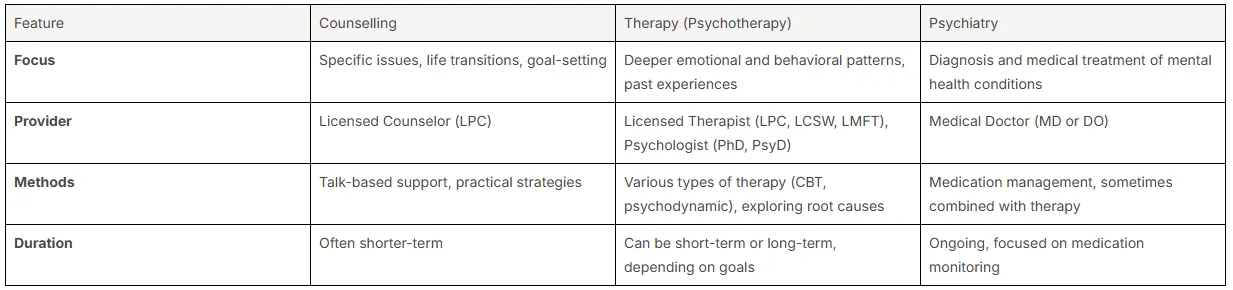
When seeking help for your mental health, you might encounter the terms counselling, therapy, and psychiatry. While they all aim to improve well-being, they differ in their approach and scope. Understanding these differences can help you choose the right type of support.
Counselling often focuses on specific issues and is more short-term, while therapy can explore deeper, long-standing patterns. Psychiatry is a medical field focused on diagnosing and treating mental health conditions, often with medication. There are many types of therapy and counseling approaches.
Here’s a simple breakdown to clarify the differences in Houston:
Finding the right therapist is a crucial step in caring for your mental health. When you're looking for someone who uses mindfulness, it's important to find a licensed professional who is a good fit for your personality and needs. Your first appointment is a chance to see if you feel comfortable.
To find a reputable therapist or counselor near you in Houston, you can start by checking online directories and reading profiles. Look for professionals who explicitly mention mindfulness, meditation, or mindfulness-based therapies in their descriptions. Here are a few tips:
Trust your instincts. The connection you have with your therapist is one of the biggest predictors of success. If it doesn't feel like a good fit after a few sessions, it is perfectly okay to look for someone else.
Mindfulness isn't just about sitting still; it can also be practiced through mindful movement. Activities like yoga and Tai Chi combine physical postures, breathing, and focused attention for powerful stress relief. These practices benefit both your physical health and mental health.
While many of these practices are individual, the skills learned can improve relationships. For those seeking relational support, there are counseling options in Houston for couples or families that may incorporate similar principles of awareness and communication. Let’s explore some mindful movement practices.
Yoga is an ancient practice that unites the mind and body through a series of postures, breathing exercises, and meditation. It is an excellent form of stress management because it helps release physical tension while calming the mind. This dual focus supports both physical health and mental health.
You don't need to be flexible to start yoga. There are many different styles, from gentle and restorative to more physically demanding. You can go at your own pace and modify poses to suit your body. The core benefits include:
While yoga is typically an individual practice, the self-awareness and calmness it fosters can positively impact relationships. For targeted relational work, counseling options in Houston for couples or families are available to help improve communication and connection.
You can find daily calm by incorporating simple stretching routines into your day. Stress often causes us to hold tension in our bodies, leading to uncomfortable physical sensations like tight shoulders or a stiff neck. Mindful stretching can release this tension and has a positive effect on your mental health.
Instead of rushing through stretches, slow down and pay attention to how your body feels. Notice the sensation of the muscles lengthening and releasing. A few simple stretches you can do at your desk or in the morning are:
This practice of mindful movement helps ground you in your body and promotes relaxation. While this is a personal practice, the resulting calm can benefit family dynamics. Dedicated counseling for couples or families in Houston can offer more specific tools for relationship challenges.
Tai Chi and walking meditation are two forms of mindful movement known for reducing anxiety and preventing stress-related health problems. Tai Chi, often described as "meditation in motion," is a gentle martial art that involves slow, flowing movements coordinated with deep breathing.
Walking meditation involves bringing your full attention to the experience of walking. Instead of focusing on a destination, you notice the rhythm of your steps and the sensations in your body. Both practices are excellent for calming mental health issues. Benefits include:
These practices cultivate a calm and centered state of mind, which can improve how you interact with others. For direct support with relationship dynamics, specialized counseling options are available in Houston for couples or families.
In today's digital world, starting a mindfulness practice is more accessible than ever. Numerous apps and online resources can guide you, whether you're in the city of Houston or anywhere else. An app can be a great supplement to a therapy session or a starting point for improving your mental health.
These digital tools make it easy to fit mindfulness into a busy schedule. If you're also wondering how to find a reputable therapist or counselor near you in Houston, many of these same online platforms can help connect you with licensed professionals.
For those who prefer in-person guidance, Houston offers a variety of local classes and workshops dedicated to mindfulness. These settings provide community support and expert instruction, which can be invaluable for personal growth and developing a consistent mindfulness practice.
Attending a class can deepen your understanding and help you stay motivated. To find reputable options, you can search online for local yoga studios, meditation centers, or community centers that offer these programs. Look for:
These local resources are excellent for supporting your mental health journey. Many therapists also have recommendations for classes in the area, which you can ask about during a session.
If you prefer the convenience of practicing on your own schedule, a mindfulness app or online tool can be a fantastic resource. These platforms offer vast libraries of guided meditations, breathing exercises, and educational content to support your mental health.
Using an app can have a significant positive effect by making mindfulness meditation accessible anytime, anywhere. Many offer free introductory content, allowing you to try them out before committing. Some of the most highly recommended apps include:
These online tools can guide you through various practices, from quick 5-minute resets to longer, more in-depth sessions. While they are not a substitute for therapy, they are an excellent way to build daily habits that support your well-being.
When stress-related mental health issues become too much to handle on your own, seeking licensed services for counseling is a brave and important step. Finding the right professional for stress relief in Houston involves a bit of research, but it's well worth the effort.
To know if a counselor in Houston is licensed and experienced, start by using reputable online directories. Websites like Psychology Today allow you to filter therapists by location, specialty, and insurance. When reviewing profiles, look for:
Don't hesitate to schedule a brief consultation call before booking a full therapy session. This gives you a chance to ask questions and get a feel for their personality.
In conclusion, incorporating mindfulness practices into your daily routine can significantly alleviate stress and enhance your overall well-being. Whether through mindful breathing, meditation, or gentle movement, these techniques empower you to manage stress effectively and cultivate a sense of calm amidst life's challenges. As you explore various mindfulness methods, remember that consistency is key to reaping the benefits. If you're looking for personalized support, consider reaching out for a free consultation with our experienced therapists who can guide you on your mindfulness journey. Prioritize your mental health today, and take the first step towards a more balanced and peaceful life.
Navigating insurance for mental health services can seem daunting, but many providers in Texas make it easy. Riaz Counseling accepts a wide range of insurance plans to help you address health problems without financial stress. Taking care of your mental health should be a priority, and finding a provider who takes your insurance is the first place to start.
Finding the right therapist in the city of Houston is about discovering a good fit for your mental health needs. At Riaz Counseling, our team of professional therapists is dedicated to supporting you. Schedule your first therapy appointment by reaching out through our contact form to begin your journey.
You can trust that you are in capable hands at Riaz Counselling. Our team consists of licensed and experienced therapists dedicated to your mental health. We work with you to create a personalized treatment plan that allows you to progress at your own pace and feel supported every step of the way.
Yes, Riaz Counselling offers specialized services for a range of mental health needs, including anxiety, depression, and support for couples and families. As one of the premier counseling centers in the greater Houston area, we provide expert care tailored to help you and your loved ones thrive.
If you feel that you or someone you know, may benefit from therapy, please reach out to our office for a FREE 15 minute consultation: LINK
Stay informed about the latest research in psychology.
.png)
Navigating dual-parent family challenges with practical strategies for balance, communication, and well-being.
.png)
Benefits of dual-parent households in Houston for child development, stability, and well-being
.png)
Heal after a breakup in Houston with self-care strategies, local experiences, and professional counseling support.

Interested in a job with Riaz Counseling? Looking for Supervision for your license? Let’s Connect! We look forward to speaking with you to see if we would be a great fit for each other.
